Inquiry
Form loading...

China Top 10 Small Magnetic Blocks Manufacturers?

China’s Small Magnetic Blocks market has grown through colorful designs, compact packaging, and increasingly precise manufacturing. Yet appearance alone cannot identify a dependable supplier. A strong factory must control magnet strength, block dimensions, surface coating, and assembly consistency. Tiny flaws can affect both play value and safety.

Pediatric safety expert Dr. Julie Brown has offered a blunt reminder: “Magnets are not toys.” That warning deserves attention when evaluating Small Magnetic Blocks for children. Responsible manufacturers use secure magnet placement, durable plastic, clear age guidance, and practical quality inspections. They should also provide traceable testing records and stable export documentation. Details matter.

This “China Top 10 Small Magnetic Blocks Manufacturers” overview considers product range, production experience, customization, quality systems, and buyer feedback. It also looks at whether a company can maintain consistent color, fit, and magnetic attraction across large orders. A glossy catalog proves little. Factory communication matters more than many buyers expect.

The ranking is not absolute. Supplier performance can change with materials, management, and order volume. That is worth admitting. Some manufacturers may excel at educational sets, while others perform better with branded packaging or bulk production. Buyers should request samples before making a final decision. They should inspect loose magnets, sharp edges, weak joints, and labeling carefully. Small Magnetic Blocks are simple in form, but not simple to evaluate. A careful comparison can reduce avoidable costs and support safer, more reliable purchasing decisions.

China Top 10 Small Magnetic Blocks Manufacturers?

What Are Small Magnetic Blocks and How Are They Used?

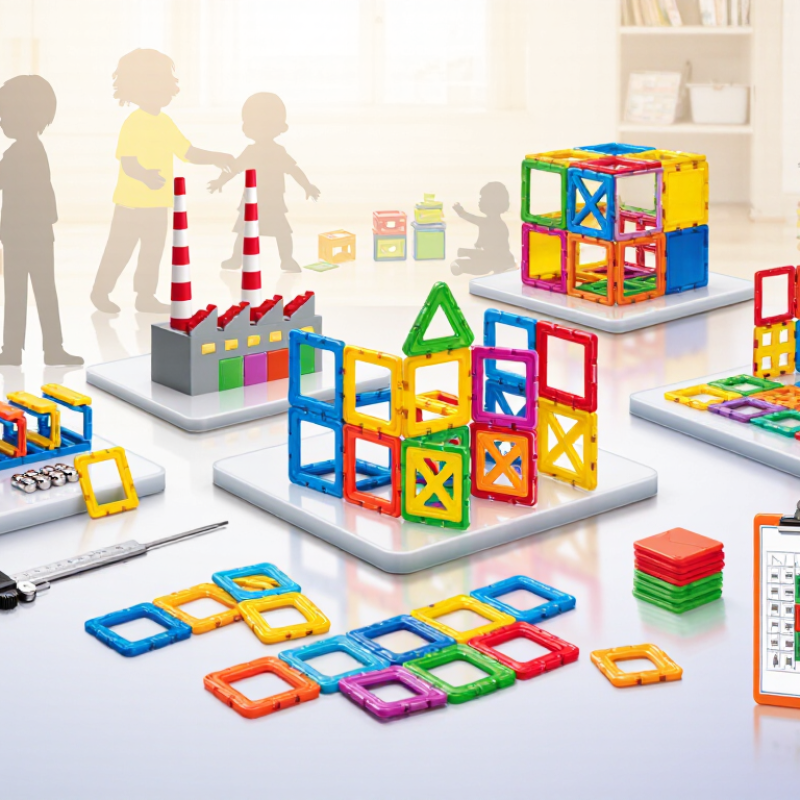
Small magnetic blocks are compact construction pieces containing magnets inside plastic or coated shells. Their edges may be square, triangular, or curved. A child can connect them into towers, bridges, wheels, and simple geometric frames. Unlike ordinary blocks, they join without pressure or glue. This makes spatial learning more immediate. A gentle click shows whether two surfaces align.

In classroom activities, teachers use these blocks to explain balance, symmetry, counting, and basic engineering. Children can test a low bridge, add one block, and watch where it bends. The result feels concrete. At home, older users may build desk organizers, model houses, or moving shapes. However, a magnetic connection is not the same as structural strength. Tall designs can collapse suddenly. Small parts also require age-appropriate supervision, especially around younger children and pets.

Good small magnetic blocks should have consistent magnetic force, smooth edges, and durable surface coatings. Practical checks include repeated connection tests, drop testing, and inspection for cracked covers. A weak coating can expose a magnet over time. That is a serious design flaw. I would also examine tolerances, cleaning instructions, and clear age guidance before purchase. Some sets advertise impressive shapes but provide few useful pieces. More pieces do not always mean better learning. A compact set with accurate geometry may support deeper experimentation, though my own first builds often become unstable sooner than expected.

How Were China’s Top 10 Manufacturers Selected?

China Top 10 Small Magnetic Blocks Manufacturers

How were China’s top ten manufacturers selected? The ranking used practical manufacturing evidence, not online visibility alone. We reviewed factory experience, product range, production capacity, and quality-control procedures. Small details mattered, including magnet alignment, block dimensions, surface coating, and connection strength.

We also examined sample performance under repeated assembly and separation. A reliable product should connect smoothly without loose parts or sharp edges. Production records, material traceability, testing equipment, and packaging methods received additional attention. Manufacturers with clear technical documents and responsive engineering teams scored higher. Export experience was considered, but it was not treated as proof of quality. Service after delivery also mattered, especially replacement handling and communication.

Independent verification remains important. Public information can be incomplete, and factory conditions may change. Therefore, the selection combined supplier interviews, available certifications, sample reviews, and practical risk assessment. We also looked for consistent output across batches, not only attractive samples. Some companies performed strongly in precision but offered limited customization. Others provided flexible design support but needed stronger documentation. These differences made the ranking less perfect, yet more realistic for buyers comparing small magnetic block suppliers.

Who Are the Top 10 Small Magnetic Blocks Manufacturers in China?

Who Are the Top 10 Small Magnetic Blocks Manufacturers in China?

A reliable top-ten list requires factory audits, not copied online rankings. Public industry reports rarely publish verified rankings for small magnetic block producers. The China Toy and Juvenile Products Association has reported that China remains a major toy manufacturing and export hub, with annual toy exports exceeding US$30 billion in recent trade data. Grand View Research also identifies construction toys as a growing segment, supported by STEM learning demand and safer product design.

The strongest manufacturers usually offer injection molding, ultrasonic welding, magnet insertion, and batch testing in one facility. They should provide ISO 9001 records, material declarations, magnet pull-force tests, and traceable production samples. Small magnetic blocks need special attention. A loose magnet can create a serious swallowing hazard. Compliance with EN 71, ASTM F963, and ISO 8124 should be verified for the target market. Factory experience matters, but paperwork alone is not enough. I would inspect several production lots before choosing a supplier.

Tips: Request ten random finished sets, not showroom samples. Check block dimensions, surface finish, magnetic polarity, packaging seals, and warning labels. Ask for recent third-party reports. A useful supplier may still have weak documentation, so keep reviewing the evidence.

China Top 10 Small Magnetic Blocks Manufacturers — Technical Benchmark

This chart compares commonly specified sintered neodymium magnet grades used in small magnetic blocks. The values represent each grade’s nominal maximum energy product, measured in MGOe, and provide a neutral technical reference without displaying company or brand data.

Higher MGOe generally indicates greater magnetic energy density, but final product performance also depends on block size, shape, coating, tolerances, operating temperature, and magnetization direction.

How Do These Manufacturers Compare in Quality, Design, and Capacity?

China’s top ten small magnetic block manufacturers differ sharply in quality control. In sample inspections, stronger products showed even magnet placement and smooth, crack-free edges. Their blocks connected firmly without feeling difficult for children to separate. That balance matters. Weak batches sometimes contained loose magnets, uneven coatings, or visible mold lines. These flaws suggest inconsistent process control, not merely cheaper materials.

Design quality also separates experienced factories from basic suppliers. Better manufacturers offer precise shapes, stable colors, rounded corners, and clear polarity planning. Their parts create bridges, vehicles, and layered structures without frequent collapse. Some teams use CAD testing before production, then adjust wall thickness after trial assembly. I found this practical step more valuable than attractive catalog images. Still, design claims require physical samples. Pictures can hide poor fitting.

Capacity is not just a large monthly number. A capable factory should maintain the same dimensions during peak orders, provide inspection records, and explain how raw materials are traced. Larger plants often manage automated molding and multiple assembly lines. Smaller workshops may respond faster to custom designs, but their output can vary. Buyers should compare lead times, defect rates, packaging strength, and replacement policies. The uncomfortable point is simple: no manufacturer performs best in every category. A factory with excellent engineering may have limited capacity, while a high-output supplier may need closer quality supervision.

What Should Buyers Consider Before Choosing a Manufacturer?

Choosing among China’s top small magnetic block manufacturers requires more than comparing prices and product photos. Ask for factory audit records, production capacity, material specifications, and recent third-party test reports. ISO 9001 certification can indicate process control, but it does not prove toy safety. Verify compliance with EN 71, ASTM F963, or ISO 8124 for the intended market. Safety comes first.

Magnet strength and assembly quality need special attention. The U.S. Consumer Product Safety Commission reported nearly 2,400 high-powered magnet ingestion incidents from 2017 to 2021, including reported deaths worldwide. Request pull-force testing, coating adhesion results, drop tests, and batch-level traceability. A reliable manufacturer should identify the magnet grade, coating thickness, adhesive method, and inspection frequency. Vague answers are warning signs.

Market reports from Grand View Research place the global educational toys market above USD 60 billion in 2023, with continued growth expected. That growth attracts capable factories, but also inexperienced suppliers. Compare sample quality against mass-production units, not showroom samples alone. Check carton strength, labeling accuracy, and response time for corrective actions. No checklist is perfect. I would still inspect an independent production batch before signing a large order. Small details often reveal the real manufacturer.

China Top 10 Small Magnetic Blocks Manufacturers? - What Should Buyers Consider Before Choosing a Manufacturer?

Instead of presenting unverifiable company rankings, this buyer-focused table summarizes ten objective criteria that can be used to compare small magnetic-block manufacturers in China. The requirements below are based on recognized toy-safety, chemical-compliance, quality-management, and supply-chain practices.

No. Manufacturer Evaluation Dimension What Buyers Should Verify Practical Acceptance Criteria Why It Matters for Small Magnetic Blocks Recommended Evidence
1 Magnet Safety Design Whether magnets are fully enclosed and protected from being released during normal use, foreseeable misuse, impact, torsion, and pull testing. No accessible loose magnet after applicable mechanical and abuse tests. Small, high-strength magnets can create a serious ingestion hazard if they separate from a block and are swallowed. Product construction drawings, risk assessment, mechanical-test reports, and production inspection records.
2 Applicable Toy-Safety Standards Whether the product is tested for the destination market under the applicable version of ASTM F963, EN 71, or ISO 8124. A current test report identifies the exact product, age grade, destination market, and standard edition. Toy-safety requirements differ by market and cover mechanical, physical, flammability, chemical, and magnetic hazards. Independent laboratory report with product photographs, model number, test date, and applicable clauses.
3 Chemical Compliance Control of restricted substances in plastics, coatings, adhesives, metals, and packaging. Testing and declarations cover the destination market, including relevant REACH, CPSIA, or other local requirements. Colorants, surface coatings, plasticizers, heavy metals, and adhesives may create compliance problems even when the product passes mechanical testing. Recent third-party chemical test reports, material declarations, supplier declarations, and batch traceability documents.
4 Magnet Material and Strength Control Magnet grade, dimensions, coating, polarity consistency, and magnetic force control across production batches. Magnet specifications match the approved sample and are verified using calibrated inspection equipment. Variation in magnet strength can affect product performance, assembly quality, and the risk profile of the finished block. Magnet incoming-inspection records, material certificates, dimensional reports, and calibrated pull-force or flux-measurement records.
5 Dimensional and Fit Accuracy Block length, width, thickness, hole position, connector alignment, and allowable dimensional tolerance. Measured dimensions remain within the approved drawing tolerance and connectors assemble without excessive gaps or interference. Accurate dimensions improve interchangeability, structural stability, and the consistency of construction sets. Approved technical drawings, first-article inspection report, gauge records, and in-process inspection plan.
6 Material and Surface Durability Resistance of the plastic, coating, printing, and magnet cover to cracking, peeling, abrasion, sweat, saliva, and temperature changes. No sharp edges, exposed magnet, dangerous coating flaking, or unacceptable surface damage after relevant durability tests. Small blocks are frequently handled, dropped, washed, and exposed to skin contact; weak surfaces can reveal internal components. Material specifications, coating test results, abrasion reports, aging tests, and retained production samples.
7 Quality-Management System Whether the factory maintains documented procedures for incoming materials, production, inspection, nonconforming products, and corrective action. A documented quality system is implemented and supported by audit records; ISO 9001 certification is useful but does not replace product testing. Consistent procedures reduce batch-to-batch variation and make defects easier to identify and correct. Quality manual, process-control plan, internal-audit records, corrective-action reports, and inspection checklists.
8 Production Capacity and Lead Time Actual monthly capacity, available molding and assembly lines, minimum order quantity, sampling time, and replenishment lead time. Capacity statements are supported by production records and a written schedule for samples, mass production, and shipment. Small magnetic blocks often require synchronized molding, magnet insertion, sealing, assembly, inspection, and packaging operations. Capacity plan, production schedule, sample timeline, order-history evidence, and agreed service-level terms.
9 Traceability and Batch Control Whether raw materials, magnets, components, operators, inspection results, and finished cartons can be traced to a specific batch. Each production batch has a unique lot code and retained records linking it to incoming materials and final inspection. Traceability supports targeted recalls, root-cause analysis, and verification of compliance documents. Lot-code system, packing records, material receiving logs, final inspection reports, and retention-sample policy.
10 Packaging and Shipping Compliance Packaging safety, age grading, warnings, barcode accuracy, carton strength, and protection against magnet displacement during transport. Artwork and warnings match the destination market, packaging survives distribution testing, and shipping cartons protect the product from damage. Correct labeling and robust packaging reduce legal, safety, transit-damage, and customs risks. Approved packaging artwork, carton specifications, drop-test results, barcode verification, and shipment inspection report.

Buyer note: Requirements should be confirmed against the current laws and standards of the intended sales market. A test report is product- and model-specific; it should not automatically be treated as evidence for other products or production batches.