Inquiry
Form loading...

China Top 10 Square Magnetic Blocks Manufacturers

Choosing among China’s Square Magnetic Blocks manufacturers takes more than comparing bright colors and low prices. Buyers should examine magnet placement, edge finishing, block dimensions, connector strength, and whether product specifications are clearly documented. A block may look smooth in a catalog, yet feel rough at the corners or connect unevenly in a child’s hand.

Design researcher Don Norman observed, “Good design is actually a lot harder to notice than poor design, in part because good designs fit our needs so well that the design is invisible.” His point offers a useful lens for evaluating Square Magnetic Blocks: reliable connections and thoughtful proportions should make building feel natural, not frustrating. Norman is a design expert, not a magnetic-block manufacturer, so this is a design principle applied to the category—not a claim about his direct industry experience.

This guide introduces ten manufacturers and the details that help distinguish them, including product range, customization, quality controls, and communication. Ask for current product specifications and sample blocks where possible. Check how the pieces join, whether corners feel consistent, and whether the supplier explains its inspection process. Small details matter. A comparison article cannot replace independent testing, and supplier information can change. Treat rankings as a starting point, then verify claims directly before making a purchasing decision.
China Top 10 Square Magnetic Blocks Manufacturers

Definition and Key Features of Square Magnetic Blocks

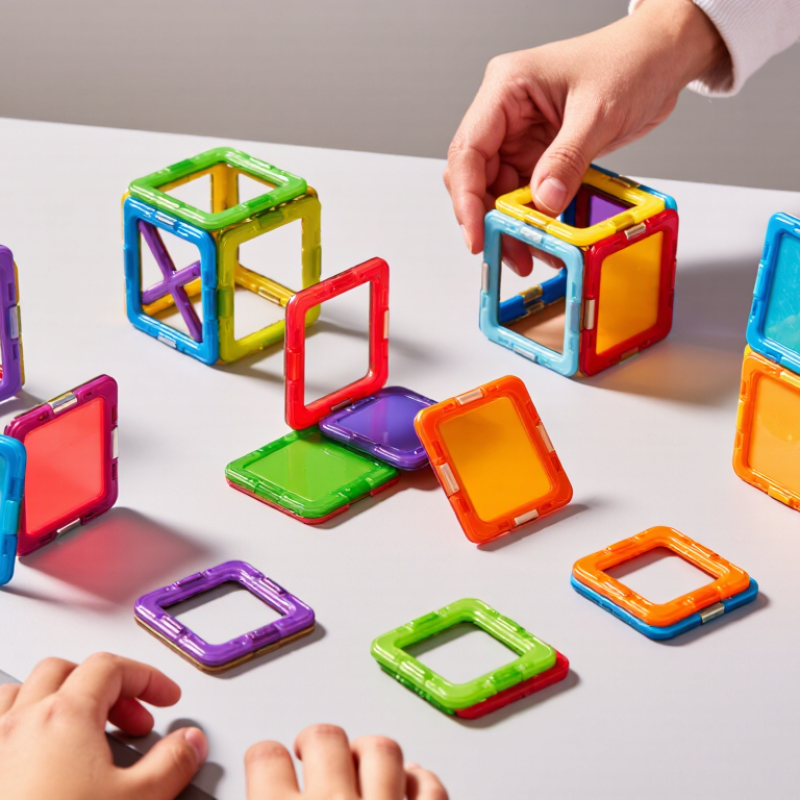
Square magnetic blocks are construction toys made from square pieces with magnets sealed inside their edges. The magnets let blocks join face to face, forming flat patterns, walls, and simple three-dimensional structures. Reliable blocks should connect consistently, sit flush, and separate without excessive force. Smooth corners and tightly sealed casings matter, too: a cracked piece can expose internal components.

Key features include magnet strength, block dimensions, material durability, and connection design. Stronger magnets are not automatically better; children should be able to pull pieces apart safely.

According to Grand View Research’s 2024 global toys market report, the market was valued at about US$108.7 billion in 2023. That broad figure does not measure magnetic blocks alone, but it shows the scale of the toy sector in which construction play products compete.

Small details count. In practical checks, test connections across different block faces and inspect seams after repeated play. Even good designs can wear unevenly.

Tips: Compare block sizes and connection feel before buying. Check for loose seams, sharp edges, or magnets that shift inside the casing. Store damaged pieces separately; appearance alone may not reveal a weakened seal.
China’s Square Magnetic Block Manufacturing Landscape

China’s square magnetic block manufacturing landscape combines mold-making, polymer processing, magnet sourcing, and final assembly. Many factories can customize block size, shell color, surface texture, and magnetic strength. The details matter. A small change in magnet placement may affect how firmly blocks connect or how evenly they stack. Buyers should ask how suppliers check magnet polarity, shell fit, and batch consistency—not just request a sample.

Tips: Request samples from the intended production process. Check whether blocks connect evenly across several pieces, and inspect seams for gaps or sharp edges. Ask for written specifications and clear inspection records. A polished sample is useful, but it cannot prove every production batch will match.

The market includes suppliers with different levels of in-house control. Some manage molding and assembly themselves; others rely on outside partners for parts. That can influence lead times and consistency, so clarify who handles each step. Ask how the factory tests magnet retention after repeated handling. Small blocks may look simple, yet loose magnets or uneven dimensions can cause real quality concerns. I would not judge a supplier by a catalog alone; factory responses and repeat samples often reveal more. A little uncertainty remains until the production run is checked.

Criteria for Evaluating Chinese Magnetic Block Manufacturers

When evaluating Chinese square magnetic block manufacturers, inspect the product, not just the catalogue. Ask for magnet-grade specifications, pull-force results, and batch-to-batch consistency data. Check that magnets remain fully enclosed after impact and torsion testing. Small gaps around a block’s seam deserve attention. Review material declarations and test reports against relevant toy-safety standards, such as ASTM F963 or EN 71, for the intended market. Confirm reports identify the exact model and materials supplied; a generic certificate proves little.

Production control matters too. Request dimensional tolerances, incoming-material checks, lot traceability, and records of corrective actions. Then compare those documents with samples from multiple production runs. Circana reported that global toy sales fell 7% in 2023, while remaining 25% above 2019 levels. That volatility makes capacity planning and stable lead times useful evaluation criteria, not just price. No checklist is perfect. A neat audit file can still miss a weak seam or inconsistent magnet placement, so independent testing and periodic sample checks add practical assurance. Share specifications in writing, including packaging and inspection plans, before placing a trial order.

Criteria for Evaluating Chinese Magnetic Block Manufacturers

Suggested evaluation weights for comparing square magnetic block suppliers

The percentages are suggested weights for a buyer’s assessment framework, not measured market rankings or scores for individual manufacturers. Prioritize product safety, magnet strength, and dimensional consistency, then verify each supplier’s specifications and quality documentation.

Profiles of China’s Top 10 Square Magnetic Block Manufacturers

Profiles of China’s Top 10 Square Magnetic Block Manufacturers

A useful profile looks beyond factory size. It examines how each manufacturer handles block dimensions, magnet placement, and edge finishing. One supplier may specialize in precise molds, while another focuses on consistent magnet assembly. Some support custom colors or shapes. Others offer ready-made educational sets. These differences matter when a sample must match a larger order.

Across ten supplier profiles, practical strengths may include small-batch production, automated assembly, custom sizing, surface finishing, export packaging, and documented quality checks. Look for clear measurements, magnet-retention tests, and samples that show clean corners under close inspection. Ask how production defects are recorded. A polished catalog is not enough. Details can be uneven.

Profiles should also explain what a manufacturer does not provide. One may have limited customization; another may need longer lead times for unusual dimensions. Check whether quoted tolerances appear in written specifications, and compare samples with those figures. Rankings can be hard to verify without shared criteria. A careful comparison is more useful than a confident label.

China Top 10 Square Magnetic Blocks Manufacturers - Profiles of China’s Top 10 Square Magnetic Block Manufacturers

Data note: No company names, rankings, or unverified factory figures are presented. The ten entries below are anonymous sourcing-profile categories, not claims about ten identified manufacturers. Standards listed are market-specific references; applicability depends on the product and destination market.

Profile Profile Focus Relevant Product or Factory Check Verifiable Reference Data That Should Be Confirmed with the Supplier
Profile 01 Core square magnetic building blocks Confirm block dimensions, shape tolerances, compatible connection edges, and whether dimensions are consistent across production batches. There is no single universal square-block size specified for this product category. Dimension drawings, tolerance limits, and pre-production samples.
Profile 02 Magnet enclosure and retention Check that magnets are securely enclosed and cannot become accessible during reasonably foreseeable use or testing. ASTM F963 includes requirements addressing toys with magnets in the U.S. market; applicable requirements depend on the toy and market. Magnet specification, enclosure design, retention-test records, and applicable test reports.
Profile 03 Plastic material and construction Identify the exact plastic resin and review the block’s seams, edges, surface finish, and resistance to expected handling. EN 71-1 addresses mechanical and physical properties of toys in the European toy-safety standards series. Material declarations, construction drawings, and mechanical/physical test documentation.
Profile 04 Material chemical safety Confirm that the finished toy and its accessible materials meet the chemical requirements applicable to the target market. EN 71-3 addresses migration of certain elements from toy materials; CPSIA requirements may apply to products sold in the United States. Product-specific laboratory reports and material or component traceability.
Profile 05 Age grading and warnings Check the intended age grade, warning text, small-parts considerations, and consistency between packaging and product documentation. Age grading and warnings are assessed under the rules applicable to the product and destination market. Age-grade rationale, artwork proofs, and market-specific labeling review.
Profile 06 U.S.-market compliance documentation For products entering the U.S. market, verify the applicable toy-safety testing and required certification documentation. ASTM F963 is a U.S. toy-safety standard; CPSIA establishes additional U.S. requirements, including applicable testing and certification obligations. Applicable test reports and a Children’s Product Certificate where required.
Profile 07 European-market compliance documentation For products marketed as toys in the EU, review the required conformity assessment, technical documentation, and labeling. EN 71 standards are commonly used to assess toy safety; CE marking indicates conformity with applicable EU legislation and is not a general quality award. EU Declaration of Conformity, technical file, test evidence, and label review.
Profile 08 Quality-management processes Review how incoming materials, in-process production, finished goods, complaints, and corrective actions are controlled. ISO 9001 specifies requirements for a quality-management system; certification does not by itself certify a toy’s safety. Current certificate scope, audit information, inspection plans, and corrective-action records.
Profile 09 Production consistency and inspection Agree on measurable acceptance criteria for appearance, dimensions, magnetic connection, assembly, and packaging. Sampling plans and acceptance limits should be agreed by the buyer and supplier; they are not universal product specifications. Written inspection criteria, sample records, and batch-level inspection results.
Profile 10 Export packaging and traceability Check product identification, batch or lot traceability, packaging information, and suitability for the destination market. Labeling and documentation requirements vary by destination and product classification. Packaging proofs, lot-code format, carton specifications, and destination-market checklist.

Applications, Quality Standards, and Industry Trends

Square magnetic blocks now serve more than free-play tables. Teachers use them to demonstrate area, symmetry, and three-dimensional geometry; designers use larger sets for quick spatial mock-ups. A child can build a windowed tower, then feel it tilt when the base is too narrow. That small failure teaches something. It also exposes a product weakness.

Quality checks should cover magnet retention, impact resistance, sharp edges, and small-part hazards. ASTM F963 and ISO 8124-1 provide widely referenced toy-safety requirements, but test scope and market rules differ. The U.S. Consumer Product Safety Commission reported about 231,700 toy-related emergency-department injuries among children aged 14 and younger in 2023. This figure covers toys broadly, not magnetic blocks alone. Still, it underlines why durability testing matters. A block that looks intact may conceal a loosened magnet.

Industry demand is changing, too. Circana reported global toy sales fell 7% in 2023 across its tracked markets, following unusually strong pandemic-era demand. Manufacturers face pressure to balance price, safety, and longer product life. Recycled plastics and modular add-ons are gaining attention, though recycled material consistency can be uneven. That is a real trade-off. Buyers should ask for test reports, material specifications, and clear age grading—not just attractive packaging.